

A robot vacuum will not replace your regular vacuum. What it will do is keep the floors from getting bad in the first place, which is a different job and, for most households, a more useful one. Run it every day while you are at work and the weekly deep clean gets a lot shorter.
The hard part is figuring out which features are worth paying for. Prices run from about $100 to well over $1,000, and the spec sheets all start to look the same after a while. This guide covers what actually matters when you are shopping for the best robot vacuum in Canada, and which models make sense at each price point.
What to Look for Before You Buy
Navigation
This is the single biggest difference between a cheap robot and a good one. Basic models use sensors to bump around the room and change direction. They get the job done eventually, but they wander, miss spots and take longer.
Mid range and higher models use LiDAR, a spinning laser on top of the robot that builds a map of your home. With a map, the robot cleans in neat rows, knows where it has already been, and lets you send it to one room from your phone. If your home has more than a few rooms, or an open layout with lots of furniture, mapping is worth the extra money.
Self-emptying base
A standard robot has a small dustbin you empty by hand, often after every run in a house with pets. A self-emptying base sucks the debris out of the robot when it docks, so you only deal with it every few weeks. If you plan to run the robot daily, this feature changes how much you actually use it.
Runtime and floor size
Most robots run between 90 and 120 minutes on a charge. That covers a typical main floor without trouble. Better models will return to the dock, recharge, and pick up where they left off, which matters for larger homes.
App and scheduling
Almost every current model connects to Wi-Fi and runs on a schedule. That is the whole point. A robot you have to remember to start is a robot that ends up in a closet.
Our Top Picks
You can browse the full range of robot and smart vacuums, but these three cover most households.
Best overall: Shark Matrix Self-Empty Robot Vacuum
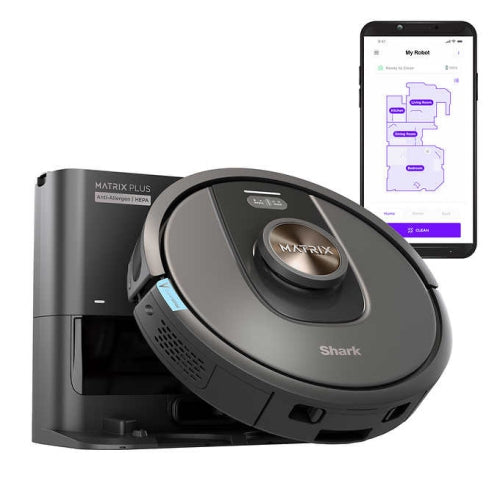
The Shark Matrix Self-Empty (RV2300SCA) at $379.99 is where we would point most buyers. It has 360 degree LiDAR mapping, runs up to 110 minutes, and docks into a bagless base that holds up to 30 days of debris. It cleans in a tight grid pattern with multiple passes, which helps with carpet and pet hair, and it recharges and resumes on its own if it runs low partway through.
For the price, getting both LiDAR mapping and a self-emptying base is the reason this one stands out. Those are often the two features that push a robot well past $500.
Best value: Shark ION Robot Vacuum (Wi-Fi)
The Shark ION (RV754CA) is a simpler machine. It uses sensor navigation rather than a map, so it covers the room in a less orderly way, and you empty the 0.43 L bin yourself. In return you get up to 120 minutes of runtime, app scheduling, Alexa and Google Assistant support, and a low profile that fits under most couches and beds.
At $249.99 it suits apartments, condos and smaller homes where the floor plan is simple and someone does not mind emptying the bin.
Best budget: Refurbished Shark ION
The same ION model is also available refurbished for $99.99. For a first robot, a rental, or a cottage you only visit on weekends, it is hard to argue with. Read the warranty and return terms on the listing before you buy, and stock on refurbished units tends to move quickly.
What About Roomba, Roborock and Other Brands?
They make good robots, and the buying advice above applies to all of them. Compare on navigation type, whether there is a self-emptying base, and the price of replacement brushes and filters. Brand matters less than people think. A mid range robot with LiDAR from any major brand will outperform a premium brand's entry level model with basic sensors.
Robot and mop combos are worth a mention too. They are convenient on hard floors, but the mopping is closer to a light wipe than a proper wash. If you have mostly tile or hardwood and want floors that look freshly mopped, plan on doing it yourself now and then.
Tips for Canadian Homes
Watch the front entrance in winter
From November to April, the boot tray is a problem. A robot that drives through melted slush and road salt will spread it across the rest of the floor. Move the tray, close off the front hall, or schedule cleaning for after the entry has dried.
Pets and shedding season
Spring and fall shedding will test any robot. Check the brushroll every week or two and cut away hair that wraps around it. A self-emptying base pays for itself during these months.
Prep the room the first time
Pick up cords, phone chargers, socks and thin bathmat fringes before the first few runs. Once the robot has mapped your home and you know where it gets stuck, you can leave things mostly as they are.
Fill the Gaps With the Right Tools
A robot cannot climb stairs, reach the top of a bookshelf, or deal with a spilled bowl of cereal in the car. Pair it with a cordless stick vacuum for stairs and quick spills, a handheld for the car, or a portable carpet cleaner for pet accidents. Our cleaning tools and vacuums collection has all of these, from cordless handhelds to wet and dry vacs.
Which One Should You Buy?
If you want the robot to run daily with as little attention as possible, get the Shark Matrix Self-Empty. If you live in a smaller space and want to keep the cost down, the ION does the job well. If you are not sure a robot vacuum will suit your routine, the refurbished ION is a low risk way to find out.
For most Canadian homes, Shark offers a lot of robot for the money, especially with a self-emptying base at under $400. See everything from robots to cordless sticks in our Shark vacuums and home appliances collection.
Share:
STIHL Battery vs Gas: Choosing Outdoor Power Equipment for Your Yard