

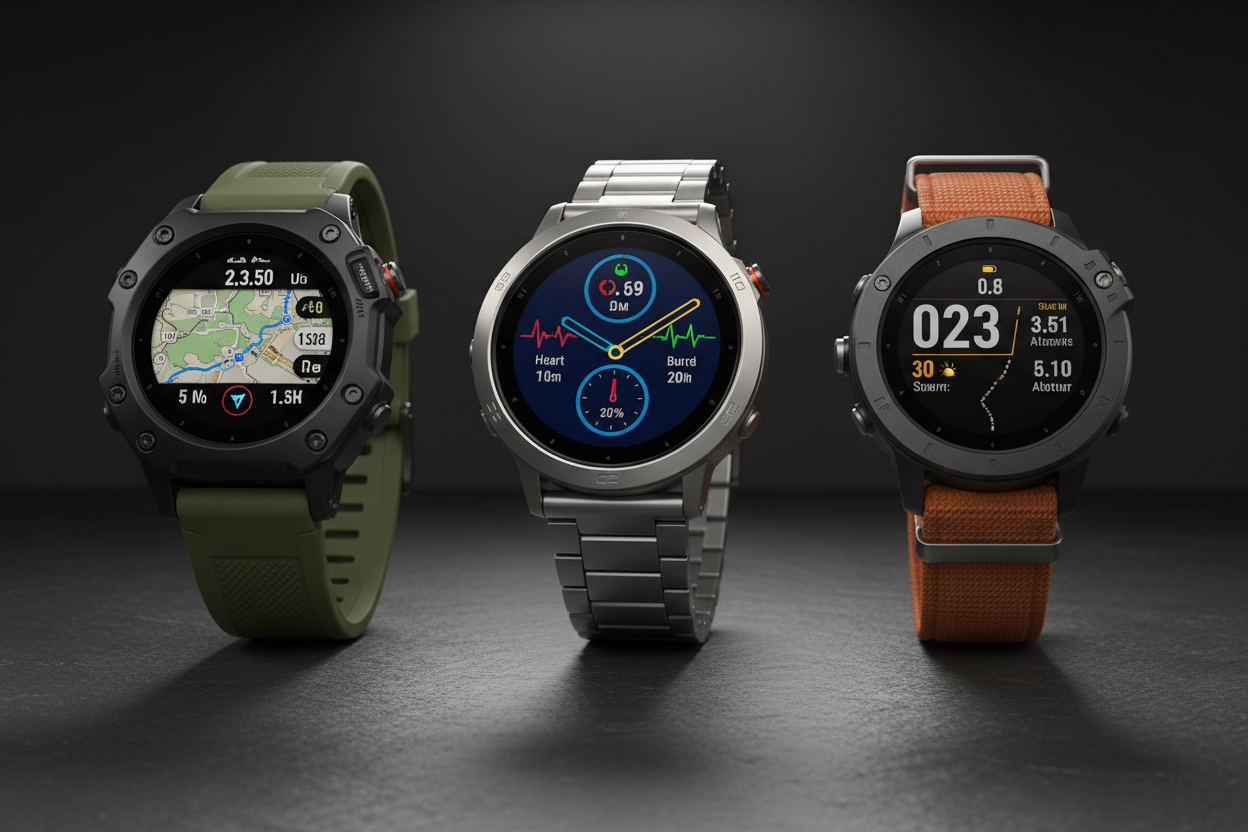
Three Garmin lines, one confusing overlap. The fenix is the mapping flagship with a transflective solar display. The Epix took the exact same software and put it behind an AMOLED screen. The Instinct is the rugged, simplified one that costs a fraction as much and skips maps entirely.
That is the summary. The useful part is knowing which of those differences will actually change your day, because two of these watches can record an identical hike and only one of them will show you where the trail goes.
The first dividing line: onboard maps
This is the split that matters most, and it is cleaner than any spec sheet suggests.
Fenix and Epix both carry full TopoActive topographic maps stored on the watch, plus ski resort maps and golf course data. You can pan around, drop a point, and have the watch route you there. No phone, no signal, no cell coverage required.
Instinct watches do not have maps. They have breadcrumb navigation, which draws the line you already walked and lets you retrace it. That is genuinely useful for getting back to the truck. It is not the same as looking at a map of the valley you are standing in.
If you spend time on unfamiliar terrain in Algonquin, the Rockies or anywhere without reliable cell service, maps are worth the premium. If you run the same routes near home and mostly want accurate data afterward, you are paying for a feature you will open twice a year.
The second dividing line: screen and battery
Fenix models use a transflective MIP display that gets more readable the brighter the sun gets and sips power. Epix uses AMOLED, which is dramatically better looking indoors and at night, and hungrier.
The fenix 7X Sapphire Solar in black DLC titanium rates up to 37 days in smartwatch mode with solar charging and up to 122 hours of GPS. Those numbers are why people take it on multi-day trips without a battery bank. The catch is that solar gain depends on real exposure, so a January hike with the watch under a parka sleeve gets you close to nothing. Solar earns its keep from May to September in this country.
Fenix 7X Sapphire Solar: the one built for going off-grid
At $1,219.99 CAD, this is the traditional flagship. 51mm case, DLC titanium bezel, sapphire lens, 32GB of storage for maps and music, multi-band GNSS, and a built-in LED flashlight with a red mode that does not wreck your night vision.
Buy it if your priority list starts with battery life and readability in daylight, and if you want a watch you can beat on for five years. The 51mm size is the honest drawback. Measure your wrist before ordering, because this is a big watch and returning it because it looks silly is a waste of everyone's time.
Epix Pro Gen 2: the same brain behind a better screen
The Epix Pro Gen 2 in 51mm runs the same feature set as its fenix counterpart. Maps, flashlight, training load, endurance score, hill score, all of it. The difference is the 1.4-inch AMOLED, which makes maps legible in a way MIP never quite manages, and which looks like a modern smartwatch rather than a piece of expedition gear.
Battery still holds up well for an AMOLED, at roughly a month in smartwatch mode and over 80 hours of GPS tracking, though you lose solar charging in the trade.
Here is the buying angle worth knowing: Garmin has since merged the Epix concept into the fenix 8 AMOLED models, so the Epix name is winding down. Discontinuation is exactly why it currently sells for $749.99 CAD against a $1,349.99 regular price. The software is still supported and still receiving updates. If you want flagship mapping and an AMOLED screen without spending $1,500 on a fenix 8, this is the sharpest value in the entire Garmin catalogue right now.
Instinct E: rugged basics, nothing extra
The Instinct E in 45mm black is the entry point, currently $279.99 CAD down from $439.99. High-strength polymer case, MIL-STD-810 tested, 10 ATM water rating, around 16 days of battery, and a monochrome display you can read on a ski hill at noon.
It has a 3-axis compass and barometric altimeter, so altitude and weather trends are covered. What it does not have: maps, flashlight, Garmin Pay, music storage, and multi-band GPS. It uses standard multi-GNSS, which is fine on open ground and less precise under heavy tree cover or between downtown towers.
For a tradesperson who wants step counts, sleep tracking and a watch that survives a jobsite, or for a casual hiker who wants breadcrumbs and weeks of battery, this covers it at a price nothing else in the lineup touches.
Instinct 3 50mm: where the lines blur
The Instinct 3 in 50mm at $729.99 CAD complicates the tidy hierarchy. It brings a 1.3-inch AMOLED display, multi-band GPS with SatIQ, a built-in flashlight, Garmin Pay and 18 days of battery into a case that is still bolted together and rated to military spec.
That means the Instinct 3 now matches an Epix on GPS accuracy and beats an Instinct E on almost everything, while still lacking maps. If you have been telling yourself you need a fenix but you honestly just want precise tracking and a tough watch, this is the model to look at before you spend $1,200.
Picking one
Ask yourself one question first: will you use a map on your wrist?
If yes, and you want maximum runtime with sunlight helping, take the fenix 7X Sapphire Solar. If yes, and you want the display to look good, take the Epix Pro Gen 2 while the discount lasts.
If no, and you want the toughest watch for the least money, take the Instinct E. If no, but you want accurate GPS under trees, a flashlight and a bright screen, take the Instinct 3 50mm.
The mistake worth avoiding is buying the flagship for features you will admire but never open. The Instinct 3 covers what most Canadian outdoor users actually do, at four hundred dollars less than the fenix.
Share:
Best Garmin Watch for Every Budget in Canada (2026)
Best Cordless Drill Combo Kits in Canada (2026)