

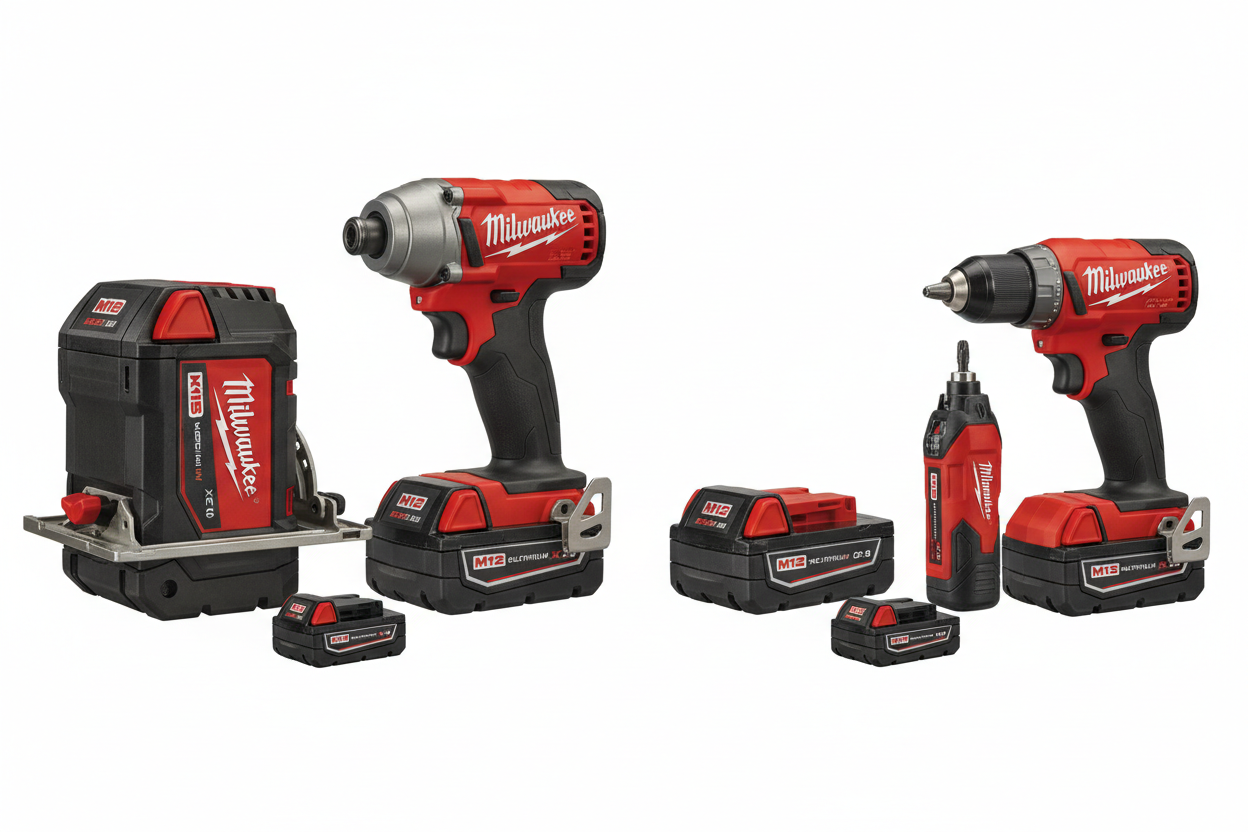
Milwaukee runs two separate cordless systems, and they do not share batteries. That trips up a lot of first-time buyers who assume a red battery is a red battery. It is not. M18 and M12 are built for different jobs, and picking the right one saves you money and frustration later. Here is how to choose.
The core difference in one line
M18 is the muscle. M12 is the finesse. M18 runs at 18 volts and powers the heavy stuff like circular saws, big impact wrenches, grinders, and hammer drills. M12 runs at 12 volts and lives in the compact, lightweight tools you reach for in tight spaces and long shifts overhead.
Neither one is better. They are pointed at different work. The trick is matching the platform to what you actually do most days, not to whichever kit happens to be on sale.
What M18 is good for
M18 is the flagship, and it carries the bulk of Milwaukee's range. If a tool needs to move a lot of material fast, it almost certainly lives here. Framing crews, renovators, mechanics pulling lug nuts, and anyone cutting or drilling into tough material want M18.
The runtime is the other draw. An M18 pack simply holds more energy, so you spend less time swapping batteries on a busy day. The tradeoff is size and weight. M18 tools and batteries are chunkier, and you feel that over a full shift of detailed work.
If you are building a kit that has to handle whatever the job throws at it, M18 is the safer foundation. You can browse the full Milwaukee cordless tool range to see just how many tools share this one battery.
What M12 is good for
M12 gets underrated because people fixate on power numbers. Spend a week with it and the appeal makes sense. These tools are small, light, and easy to work with in cramped spots where a full-size drill just does not fit.
Electricians love M12 for working inside panels. Plumbers use the compact tools under sinks and behind toilets. Mechanics keep M12 ratchets in the box for spots a big impact cannot reach. Anyone doing detailed, repetitive, or overhead work benefits from the lower weight, since your arm knows the difference after a few hours.
M12 also covers a surprising amount of ground beyond the basics. Inspection cameras, soldering irons, heated jackets, caulk guns, and specialty diagnostic tools all run on the same little battery. For a lot of trades, an M12 kit handles most of the daily grind, and M18 only comes out for the heavy jobs.
The batteries are not interchangeable
This is the part worth repeating, because it is the most expensive mistake to get wrong. An M18 battery will not fit an M12 tool, and an M12 battery will not power an M18 tool. The platforms are physically and electrically separate.
That means every battery purchase commits you further to one side. Amp-hour ratings matter here too. A higher Ah pack runs longer between charges and, on many tools, delivers more sustained power. On the M18 side, a workhorse like the M18 RedLithium High Output XC 6.0Ah battery gives you long runtime and extra grunt for demanding tools. On the compact side, the M12 RedLithium XC 6.0Ah extended capacity pack squeezes serious runtime out of a battery that still fits in the palm of your hand.
Buy your batteries with the same care you buy your tools. They often outlast the tool anyway.
Can you run both platforms?
Plenty of people do, and there is nothing wrong with it. A lot of pros end up with an M18 kit for the big work and a handful of M12 tools for detail work. Milwaukee even sells multi-voltage chargers that top up both, which keeps your bench tidy.
The only real downside is cost. You are now maintaining two battery collections instead of one, which adds up. If budget is tight, start with the platform that matches your most common task, get it fully sorted with a couple of spare batteries, and add the second system later once the need is obvious.
How to decide
Ask yourself what eats up most of your day. If you are constantly cutting, drilling into hard material, driving big fasteners, or need long runtime without babysitting the charger, lead with M18. It is the platform that says yes to almost everything.
If your work is detailed, repetitive, done in tight quarters, or spent holding a tool overhead, M12 will make your life easier and lighter. Many finish carpenters, service electricians, and maintenance techs live mostly on M12 and rarely miss the extra power.
Homeowners often do well starting on M12 for a simpler reason. Most household jobs like assembling furniture, hanging shelves, and light repairs do not need the muscle of M18, and the compact tools are far less intimidating to store and handle. That said, if your home projects lean toward decks, renos, or serious yard work, M18 earns its keep.
Getting the most value
Whichever way you go, combo kits are almost always the cheapest path onto a platform. A kit with two batteries, a charger, and a couple of tools works out to a much lower price per piece than buying everything bare. The batteries alone usually justify the kit price.
It also pays to time your purchase. Battery and kit prices swing a lot through the year, so it is worth checking the current tool and battery deals before you commit. A good sale on a starter kit is the easiest money you will save on this whole decision.
Bottom line
M18 for power and runtime. M12 for size and comfort. The batteries do not cross over, so choose based on the work you actually do, buy a combo kit to get started, and add spare batteries with decent amp-hour ratings so you are never stuck waiting on a charger. Get that right and either platform will serve you for years.
Share:
Milwaukee vs DeWalt vs Makita: Best Cordless Tool Brand in Canada (2026)
Best Garmin Watch for Every Budget in Canada (2026)